
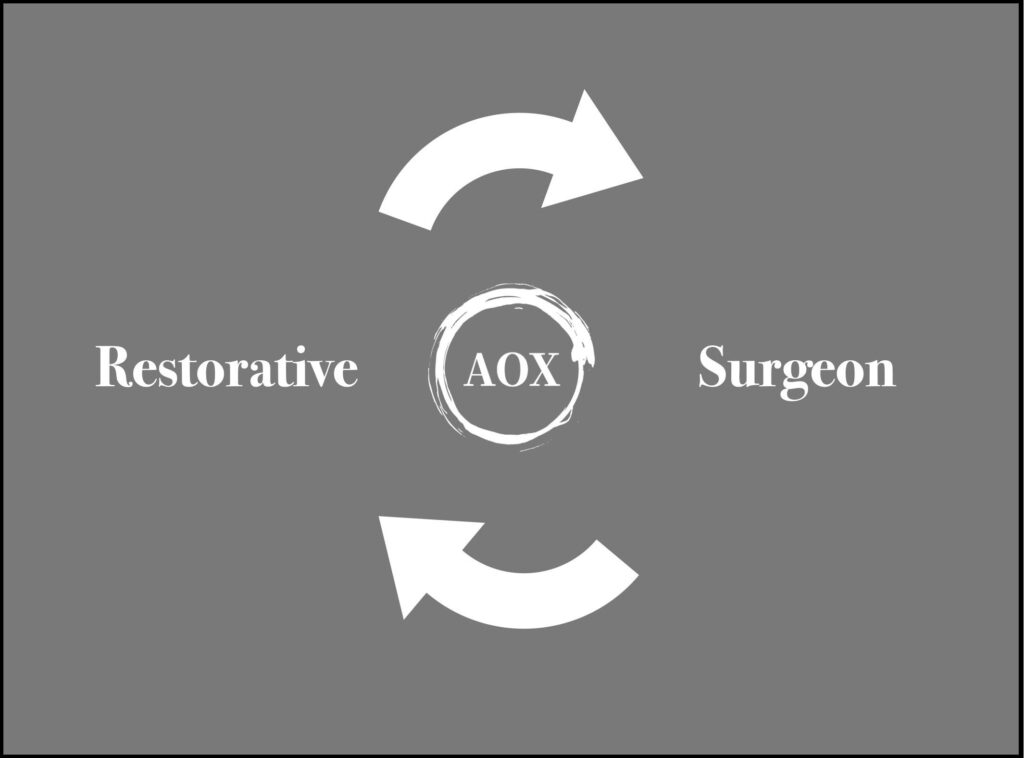
For those of you working in, and/or considering working in a full-arch style practice, it is no secret that the working relationship between the restorative doctor and the surgeon is paramount to the success of the practice. This relationship has a much different dynamic in a private practice setting – but is no less important.
What makes full-arch surgery unique is the demands it places on two separate providers to truly work together in order to achieve an optimal outcome. While this can be said about other areas of dentistry, the significant reliance on strong clinical work on BOTH the surgical and prosthetic side is not demanded at such a high level, or with such high stakes, in other areas of the dental field. A weak point in AOX treatment in either area of expertise can lead to surgical/prosthetic failures, unhappy patients, and a frustrated working environment.
Given how much pressure rides on this working relationship, I have received a number of inquiries from prosthetic providers, who are not necessarily performing the surgery, but have all asked something similar to the following:
Although not a question I anticipated being popular – it has been asked again and again and again.
As such, I’ve included my response in today’s newsletter.
As I’ve mentioned many times, I am not a restorative doctor. While I have quite an extensive prosthetic knowledge from being around full-arch surgery for years – I am definitely not a prosthetic expert. And, I am not about to tell anyone how they should perform the restorative aspect of full-arch surgery.
With that caveat, I will answer the question above from a surgeon’s point of view.
In order to optimize your working relationship (as a prosthetic provider) with your surgeon and improve AOX outcomes, I would recommend the following (a surgeon’s opinion):
1. Meet with your surgeon when you first start and discuss their full-arch treatment philosophies.
What types of cases will they generally do? What types cases won’t they generally do? Do they perform pterygoid implants? Zygomatic implants? How do they manage complex cases? Are they ok with local anesthesia if necessary? What are their medical red flags (meaning medications or medical problems they won’t treat or prefer to avoid)?
Remember that in a full-arch style practice you (the prosthetic provider) will be doing the vast majority of the initial consults. So, understanding your surgeon’s preferences is paramount to success and a smooth practice flow. And remember that every surgeon is different. Get to know YOUR surgeon.
2. Try to review at least 100 CT scans with your surgeon.
It’s not always possible to review every scan together at first – but the more scans you can review with your surgeon – the faster you can understand what they look for when assessing a case and how they create a treatment plan. This is the best way to get a glimpse into their “AOX mind”.
How much bone is “generally” enough and in what locations are they assessing that bone to make a case doable? How much bone is too little? If the surgeon you work with performs zygomatic implants and/or pterygoid implants, how do they assess those regions on the scan?
I know this sounds like a lot of scans (and a lot of time), but in a full-arch style practice – this only takes a couple weeks if you review consultation scans together.
You will always, and should always, have the ability to discuss cases directly with your surgeon. However, since they are often “in surgery” – understanding these criteria to help initially screen patients will make the process for you, the patient, and the team go smoother.
This is no different for a restorative doctor in a private practice who initially evaluates a full-arch patient. It is much easier to sell a case and set a patient up for a positive experience with your referral surgeon when you can look at a scan and have a pretty good idea of what the surgeon will do clinically with that case.
*Tip: If you are a private practice OMFS, you can effectively accomplish this goal for your top restorative providers by hosting a dinner and spending 30-45 minutes reviewing at least 25 scans with them.
3. Build a relationship with your surgeon where you feel comfortable calling or reaching out with a question if they aren’t in the office.
This might be in regards to a CT scan, a medical question, or a follow-up question involving a surgery patient etc.
I know that some surgeons are more approachable than others. Regardless, you will absolutely have times where you have questions. You need to be able to communicate well with your surgeon. I realize that this is usually more so on the surgeon than you – but this is something that is critical to help cultivate.
4. In order to help ensure surgical results are prosthetically driven to your liking – perform a bone reduction check and an abutment check.
Intra-operatively, after I complete bone reduction, I call the prosthodontist I work with into the OR. They glove up and clinically assess bone reduction and VDO to ensure they are happy with the restorative space. If they (or you) are NOT – then NOW is the time to say something.
Nightmare scenarios can be created when reduction is inadequate. This problem is easy to avoid if you check during the surgery – before implants go in. If you wait until the pick up or post-op appointment to assess this… it’s too late and that nightmare scenario has been created.
Second, is the abutment check. After placement of the multi-unit abutments, I call the prosthodontist once again to return to the OR. They evaluate abutment position, angulation, and A-P spread (and again confirm adequate restorative space) to ensure we are both happy from a prosthetic and surgical standpoint. The goal is to never have to change an abutment after this point in time. Limiting changing of the abutments is better for the health of the implants and avoids some acute intra-operative complications that can occur with abutment switches. It also makes your prosthetic pick-ups far more efficient and enjoyable.
I would like to add that these two steps are even more important if your surgeon is less experienced/new to the full-arch world. And the same goes for you if you are less experienced as a full-arch restorative doctor. There is a point where the “checks” become less critical, when you have an extensive amount of experience working together. That being said, after over 1000 arches with my current prosthodontic colleague – we still check every single case we do together for both adequate bone reduction and optimal abutment position.
5. Finally, in this field – bedside manner is everything.
You are dealing with patients day in and day out with high dental anxiety and often previous traumatic dental experiences, coupled with the fact that they have received a substantial maxillofacial surgery. Being able to talk to these patients, listen, empathize, and help guide them on their journey will go a long, long way in your full-arch success both on the prosthetic and surgical end. If your surgeon knows you have their back, they will gladly reciprocate.
Remember, AOX surgery is a team sport. None of us can do it alone.
Matthew Krieger DMD
“If everyone is moving forward together, then success takes care of itself”
Henry Ford