
Crestal or Subcrestal?
There are many different opinions when it comes to crestal versus subcrestal implant placement.
I don’t technically fall into either camp.
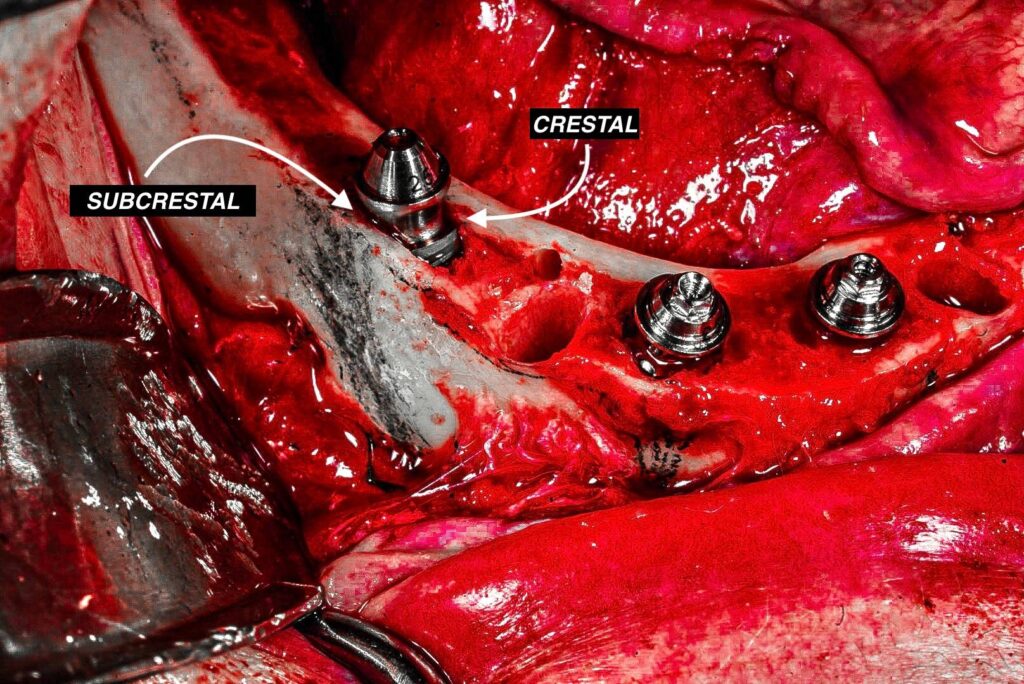
My preference for AOX implants is somewhat crestal… and somewhat subcrestal.
I call this the “crestal-subcrestal” approach.
There is a very simple and rationale reason for this “one foot in and one foot out” strategy:
So why does the angulation of the implants matter with regards to implant depth?
As such, I prefer to have the mesial portion of the angled implant at a “crestal” level and the distal portion of the implant at a “subcrestal” bone height.
I specifically avoid placing both portions of the implant subcrestal. Ok…ok – sometimes this will naturally occur following “timing” of the implant. However, I am almost never trying to significantly submerge the entire 360 degree implant platform in a subcrestal nature.
And why, you might ask, do I prefer this “cresal-subcrestal” approach?
Well, listed below are 3 reasons as to why I feel this is the best approach regarding implant position/depth.
1. The crestal-subcrestal approach maximizes some of the benefits of subcrestal placement without creating bone impingement of the abutment.
If you place your implants significantly subcrestal, you have to be aware of the surrounding bony architecture as it can interfere with fully seating the abutment.
Worse yet, it can “feel” like you’ve seated your abutment and have actually torqued the abutment screw. However, you may later realize that it is not actually fully seated as it is hung up on adjacent bone. The bone impingement generated friction that allowed the torquing of the abutment screw and created a false “temporary stability”.
In this case, hopefully the inadequately seated abutment will be noted on a post-op scan. If not, it’s hard to miss when the implant comes back as a failure due to micro-movements at the abutment/implant interface…
2. The crestal-subcrestal approach allows you to more easily change an abutment later should you need to (although I always recommend changing abutments intra-operatively during an “abutment check”).
If you place your implants entirely subcrestal, there is a much higher probability that if you or your restorative doctor attempt to change an abutment after surgery – resistance and/or difficulty seating the abutment may be encountered.
This is due to bone impingement of the new abutment angle and/or position, coupled with the fact that you have lost direct visualization of the site due to closure of the wound.
And as a result, you are now unable to fully seat the abutment without re-opening the flap and performing bone profiling at the implant site.
*Remember that at true subcrestal levels just because a multi-unit abutment fits one position – does NOT mean it will be able to automatically be rotated to fit other positions (and or change MUA angles) without bone interference.
3. At a crestal-subcrestal implant level, with adequate patient hygiene, I don’t notice any significant bone loss with the implant system I use (Neodent – Helix). I will note that in the past I have used other systems for single implant cases where an initial 1- 2mm of bone loss was simply expected in the first 6+ months. As a result, there was a significant motivation to place the implant a couple of millimeters subcrestal. I do not currently find this to be the case in my hands in the setting of full-arch surgery and with use of the Neodent Helix.
Matthew Krieger DMD
P.S. One exception would be my lower anterior implants, which are normally (but not always) more or less “straight or vertical”. Since these are usually not angled implants (and normally receive a straight abutment) they are most often placed to a crestal position.
P.P.S. I want to be clear that I am not “endorsing” or “marketing” the Neodent implant. I do happen to personally prefer this implant. However, I am simply including the name/type of implant I use as I feel it is relevant to the anecdotal clinical information presented.
“You don’t always have to be right. But you always have to have a reason for everything you do.”
Wise words instructed to me my first week as a PGY-1 Resident. *Paraphrased, as best as I can remember, from my residency chief: Dr. Bobby Horne / CCHS OMFS.
Q & A with Dr. K
“If you could hand select a ‘first arch’ for a beginning surgeon what would it be?” |
Dentate maxilla with bilateral second pre-molars and incisors intact (ideally 6-ish teeth present).
I prefer operating on the maxilla. I enjoy not having to deal with the tongue and floor of mouth. There are also more “safety” options built into the maxilla (even if that means you need to perform a sinus lift at this stage in your AOX journey).
While “edentulous” sounds “easier” – I prefer a partially dentate patient. A socket lets me know there will be some degree of cortical bone I can work with and a more predictable ability to generate torque.
I selected 2nd bicuspids to be present because that tells us we should be able to achieve a second bicuspid spread which means the arch will most likely be manageable with a traditional four implant configuration.
I also referenced having anterior incisors in place. This was to ensure there was adequate bone volume and width in this region, which would avoid the need for advanced techniques.