
It is said that experience breeds both greatness and humility.
This could not be more true than in the world of AOX surgery.
While confidence is important, the more experience I have gained, the more respect I have found for each and every arch that I cut.
Humility comes with experience.
And believe me when I say that I have learned firsthand to never, ever, underestimate an arch.
Even what appears to be the simplest of arches can, in the blink of an eye, transform into an incredibly complicated and difficulty surgery.
As surgeons, this becomes even more challenging to manage if we are not mentally prepared and are expecting a “cakewalk” case.
Always be prepared.
Listed below are 3 things that I do to mentally prepare – even when the arch on the schedule appears to be an “easy surgery”.
1. I mentally prepare for at least 3 possible treatment scenarios.
Having a plan is important. But having one plan is unrealistic.
Something almost always seems to change intra-operatively. A buccal plate fractures. The bone is less dense than anticipated. The initial implant doesn’t torque well, etc.
This is why my goal is always to have a minimum of 3 possible surgical treatment plans. While this is not always possible – the vast majority of the time it is (and even 4 or 5 plans is not unrealistic).
You can read more about the value in creating multiple treatment plans here: The Cardinal Rule of AOX Surgery: Always leave yourself outs.
2. I discuss prosthetic flexibility with my restorative colleague.
This means that I want to know what can and/or cannot be done on the prosthetic side if things are looking less than ideal surgically.
If it’s a double jaw – do we have some leeway to move the prosthetic slightly anterior to eliminate a posterior cantilever? Or can we move slightly posterior to eliminate an anterior cantilever? Is the patient open to a shortened arch if necessary? Etc.
The answers to these questions help me to know which surgical strategies to pursue intra-operatively.
3. I prepare for a seamless intra-operative transition from one treatment plan to the next.
Being adaptable is paramount to full-arch success. But being adaptable doesn’t just mean “thinking on the fly”. In fact a key component of adaptability is being prepared.
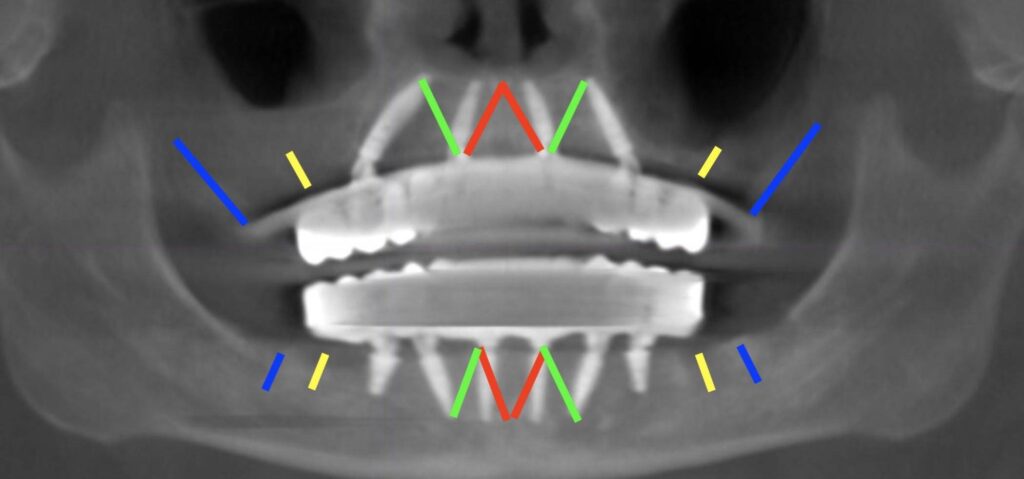
When I compile my 3 or 4 pre-op treatment plans, I mentally note probable implant sizes and even angles of implant insertion should I need to change course intra-operatively.
If my “Plan B” includes palatal root implants, the 5×8 implants are already in the room and ready to go.
If my “Plan C” includes pterygoid implants, I have already reviewed the scan at the pterygomaxillary pillar and know the angle and size of the desired implants to be placed.
There should be no hesitation – no questioning what to do. The goal is a seamless transition into one of the already prepared treatment plans.
If you haven’t been humbled by an arch yet – you haven’t cut enough arches.
It’s coming.
Never underestimate an arch. Always be prepared.
Matthew Krieger DMD
“There is no greater danger than underestimating your opponent.”
Lao Tzu
Q & A with Dr. K
“What are your most commonly used implant sizes?” |
In a traditional “All-On-4”:
Maxillary & Mandibular Posterior Sites:
4mm x 13mm
Maxillary & Mandibular Anterior Sites:
4mm x 11mm and/or 4mm x 10mm