
AOX surgery is a different animal.
There is an unparalleled reward and an unmatched sense of fulfillment for the surgeon upon completion of an AOX case.
However, there can also be a lot pressure and stress while working toward that final suture.
And, on top of that gamut of emotions – just when you get to feeling like you’ve got it all down – this surgery has a way of quickly humbling you.
I was reminded of the humbling nature of AOX surgery this past week.
I had a very difficult, severely atrophic maxilla on the schedule. This was a patient who had worn a denture for decades and been turned down for surgery at every other consult.
Due to the complexity, I did have a very detailed pre-op consultation with the patient where we discussed the possibility of a delayed load. But I knew this wouldn’t actually be the case.
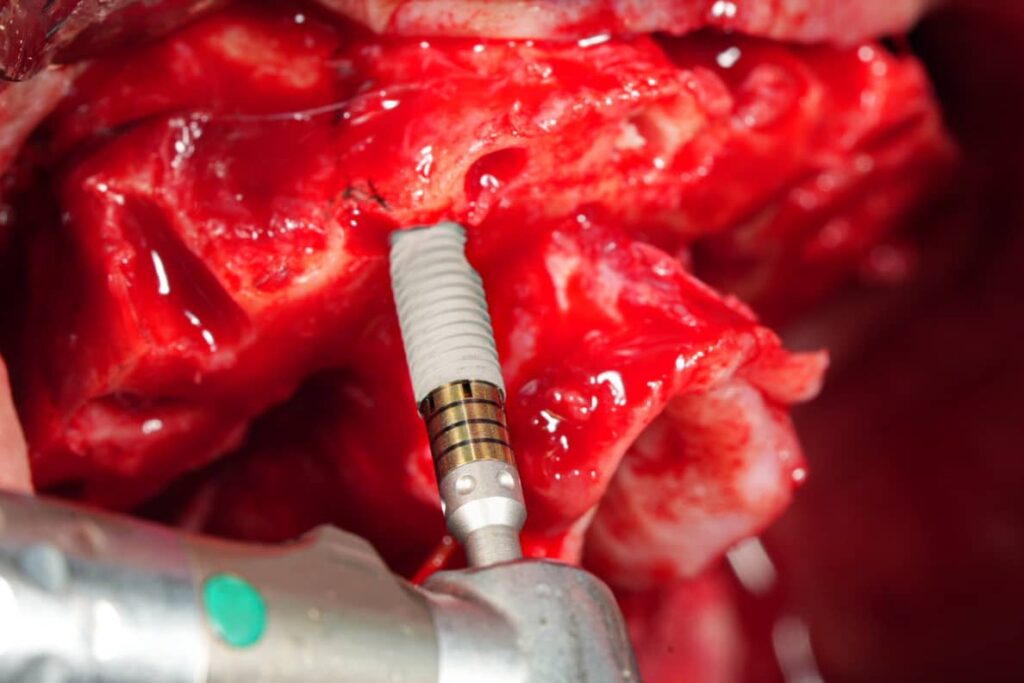
Intra-operatively, I placed six implants: Two pterygoid implants, two implants at the bilateral pre-molar locations, and two at the anterior nasal crest. A combination of remote anchorage, strategic placement, and a palatal based approach was utilized.
The pre-molar implants were a generous torque of 15 N-cm. The bilateral pterygoid implants registered at 30 N-cm and the anterior nasal crest implants at 30 & 60 N-cm.
I had a tough decision to make.
I did technically have enough torque to load. Actually, slightly more than enough torque to load.
However, this patient was extremely atrophic and also presented with very low density bone (often atrophic patients actually have higher density bone due to the cortical walls of the atrophic alveolus).
I also do not like to load implants with less than 25 N-cm of torque. Therefore, if I buried the pre-molar implants, there would be no implant support between the posterior pterygoid and anterior nasal crest.
I was concerned that, even though the composite torque was adequate – it was barely adequate. And, there was a huge distance from anterior to posterior with no implant support. And, if anything failed, I didn’t have many more options aside from zygomatic implants and/or bilateral sinus grafts.
Not to mention, to add to the stress and pressure – I had a new doctor that had joined the practice observing me for this surgery who had been following me on social media. He was excited to see “how the magic was made“…
With the pressure mounting, I tried to make a sound decision. As I am not a huge fan of zygomatic implants, I made the difficult decision to bury the case and uncover in 4-5 months.
The patient was already in a denture pre-op (and had been for years) and knew temporary continued denture wear was a real possibility. And, honestly, she was completely happy with the outcome.
However, this was quite a shot to my ego.
This is only the second arch in 5 years that I have not immediately loaded at the initial surgery. I also did something else I had yet to do in 5 years – I buried pterygoid implants.
I left that case defeated.
Should I have loaded with the torque I had?? Despite my dislike of zygomatic implants – was this a case I should have placed them? Was there something I missed intra-operatively that could have changed the course of the case and allowed an immediate load?
I started to get lost in my mind re-analyzing what I could have done to immediately load.
I had to stop myself.
While it was important to analyze and learn from the case – when I really looked deep inside – the only reason I was re-hashing the opportunity to immediately load is that I wanted to continue to be able to say I had only every NOT immediately loaded one case.
Now, I had to say that there were TWO cases I didn’t immediately load.
This was incredibly selfish and small of me.
Ultimately, I made the intra-operative call that I felt was best for the patient. I felt a more predictable outcome would be obtained by burying the implants. And, while I know it’s a controversial topic, I felt it better at this stage to avoid zygomatic implants for this patient.
This patient had been turned down everywhere else she had went and was thrilled we were simply able to take on her case at all. She was happy.
I had to remind myself that my goal – no my duty – as a surgeon is to treat my patients, not to treat my ego.
I felt compelled to share this experience with you today.
For me this was a reminder that:
- AOX surgery is difficult. We are all wise to maintain a humble attitude – or we will be humbled eventually.
- I am not a magical surgeon. I have difficulties. I have cases that don’t go like I want them to. I learn the hard way too. And I still have a lot left to learn.
- We all should remember to treat our patients how we feel is truly best for them – given our own unique skill sets and experience. We should never treat our ego.
Here’s to wishing you AOX humility and success.
Matthew Krieger DMD
“Humility is not thinking less of yourself, it’s thinking of yourself less.”
C.S. Lewis
Q & A with Dr. K
“If you had to choose – What would be the ONE most important skill you would recommend someone new to AOX focus on? “ |
In my opinion, this is the single greatest attribute of an AOX surgeon.
When you begin, you should be focusing on straight forward full-arch cases.
You need to build confidence and AOX fundamentals as you progress in your arch goals.
However, just because your arches might be “straightforward”, doesn’t mean you shouldn’t learn to be adaptable. In my opinion, this does not mean learning pterygoid and zygomatic implants when you first start out.
With an appropriate case selection, you do not need these advanced skills when you begin your journey. You can and should learn to be adaptable within your current skill set.
Even without remote anchorage, you should be able to have 3-4 potential surgical treatment plans for any given “standard” full arch case. Practice forming different treatment plans and being able to adapt intra-operatively.
This is the single most important full-arch skill, and one that you will never stop learning and perfecting.
If you think you’ve got it down perfectly – you’ll find yourself in the position I was above. Keep learning and working to become more and more adaptable. It will serve you well in your full-arch journey.