

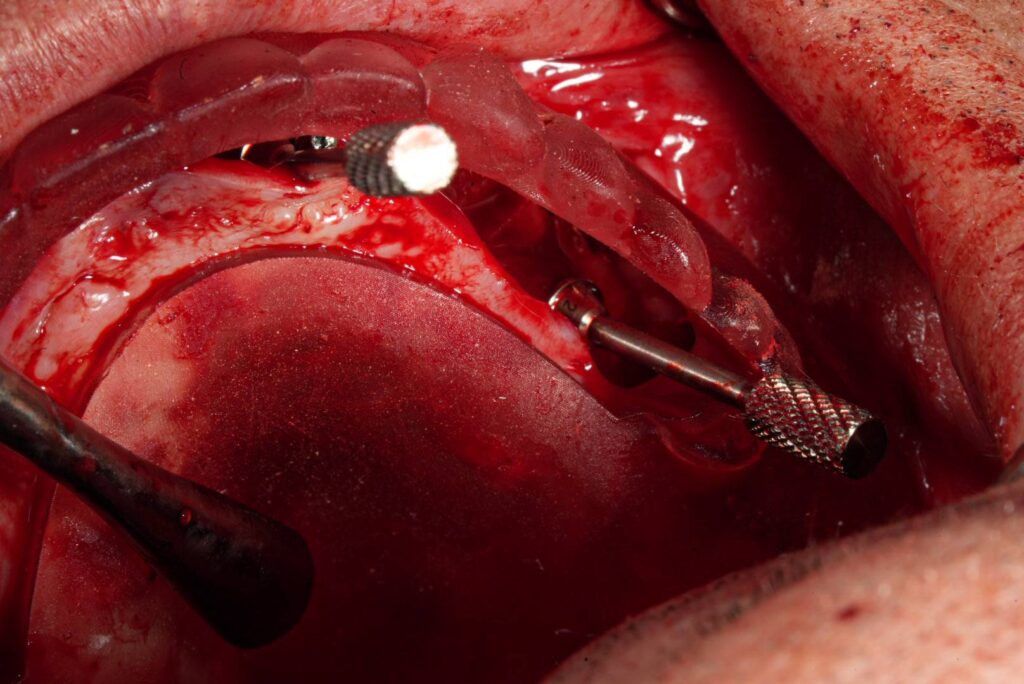
I am shocked at how many times I’ve been asked:
“Do you place your own abutments?”
My response is always,
Since I began writing ArchGhost.com, I have encountered the following two recurring thoughts by more than a handful of referral based surgeons:
- I can place the abutments in the “general vicinity” and the restorative doctor can adjust them later if needed.
- I can just place, well, anything – and the restorative doctor will place the abutments they want when the patient gets to their office.
For those in a referral based practice, I wanted to touch briefly on why this really isn’t a great way to practice full-arch surgery and why this thought process – while somewhat logical, really does not pan out.
First of all, it is actually very rational as a surgeon to assume that the restorative doctor can easily “switch” the abutment to their liking. I thought this way when I first began performing AOX surgery as well.
It is a multi-unit abutment after all. It has multiple positions right? So, our restorative colleague has lots of options to choose from… Right?
Ehhh. While this does make sense on the surface – I’m sorry to say that it’s just not true most of the time.
Even though MUA’s typically have 6 positions, you really don’t have 6 options.
The vast majority of the time only ONE MUA position will correlate with an acceptable angulation and subsequent access hole position. And if there are actually 2 acceptable abutment positions – then it’s almost certain that neither one is in an ideal orientation.
The benefit to an angled multi-unit abutment isn’t really that there are multiple positions – it’s that the abutment has an arc of rotation that can be adjusted to perfect the position of the access hole.
This is done by rotating the implant and allowing the MUA to rotate into its subsequent “ideal” position.
The only way to truly optimize an abutment position, is actually by optimizing the implant placement and rotational orientation.
This is done not only by the angulation at which the implant is placed in the bone, but also by rotating the implant to the desired position along that abutment arc.
And you guessed it… All of this manipulation of the implant should be done by the surgeon.
Abutments really are a surgical skill and responsibility.
If the surgeon does not get the abutment positions in a strong prosthetic position, there’s really not a lot the restorative doctor can do – UNLESS – we are ok with them rotating our implants.
And we all know the answer to that question.😬
Matthew Krieger DMD
“You must own everything in your world. There is no one else to blame.”
Jocko Willink
Q & A with Dr. K
“What torque will you not load? “ |
I want a composite torque of >120 N-cm to load a full-arch prosthetic. This is a well accepted value supported by literature.
I try not to load any single implant in the arch that has a torque less than 20 N-cm.
The rational for this is that the MUA abutments I use need to be torqued to 20 N-cm. So If the implant has a similar torque value, it is likely to rotate when torquing the abutment.
There are some tricks to avoid this potential rotation of the implant when torquing the abutment, but this is a point at which I usually look for other options and “outs”.