

Failure.
We all want to avoid it. We all hope that it doesn’t happen to our full-arch cases. We all want to believe that everything is going to work out wonderfully.
While I’ve been known to be a bit of a pessimist, and I will acknowledge that I could benefit from a more optimistic outlook in many situations – full-arch surgery is not one of them.
Sure, it is absolutely necessary to be able to appropriately treatment plan a full-arch case for success, and to do so with confidence. But, that is where many practitioners stop – including myself at the beginning of my career.
Now, I approach cases differently.
When treatment planning a case I always ask myself Two Questions:
- How I am going to make this case work?
- How am I going to rescue this case if something fails?
I frequently receive questions from practitioners asking “what to do when an implant has failed”. This is a normal part of the AOX learning curve and one that we will all get better at with time and practice.
However, my goal (and my advice for other practitioners) is not to wait until an implant fails to try to figure out what to do.
I embrace the failure mindset.
I not only treatment plan a case for success, I treatment plan a case for failure.
I want to know – before I ever cut an arch – what I’m going to do if something fails. While failure is thankfully rare, I attempt to never be caught off guard by it.
I plan to fail…
Here are the questions I ask myself in order to help “Plan for Failure”:
1. If an implant/implants fail, how big will the “fallout” be?
Are certain implants (such as a midline implant) so close together that adjacent implants are likely to be affected by a failure?
Are implants placed with extension to the inferior border and a failure could result in a larger complication to manage?
2. What are my outs?
What are the likely avenues of rescue? Pterygoid implants? Palatally positioned implants? Short implants posterior to the foramen? Is there room to adjust and “re-angle”, etc.?
If there are not any discernible outs, then what can I do now prosthetically, or otherwise, to increase the likelihood of integration? A shortened arch? Botox therapy for bruxers? Burying an implant/implants?
3. How likely is this patient to tolerate a failure mentally and emotionally?
Is this an 80 year-old patient with a 40-year denture history that, while less than ideal, will likely tolerate a temporary transition back to a denture?
Or, is this a 35 year-old patient with a near full dentition but extensive decay and perio that, despite a poor dentition, won’t realistically tolerate a temporary denture?
4. In exceptionally difficult cases, I may consider if I am able to build-in any future outs?
Is there anything I can do now to provide a built-in contingency plan?
I may consider a sinus lift to be used as needed if a failure occurs. I may consider burying an additional implant as a back-up, etc.
5. If there is a failure, what will that look like in this patient?
Are they severely immunocompromised? Will the infection spread rapidly (poorly controlled diabetic)? What type of immunosuppressant medications are they taking?
6. In response to the question above, should surgical adjustments be made?
In severely immunocompromised patients, those on strong immunosuppressant medications, and/or medications known to impair bone healing – I will often attempt to avoid certain anatomic structures that are either more difficult to access should infection and/or osteonecrosis occur (pterygomaxillary pillar) and/or have less blood supply and are more prone to infection (inferior border).
While we should always strive for success, I believe that in full-arch surgery it is just as important – if not more important – to envision failure.
Failure will come for us all. We can either choose to be prepared or choose to be surprised.
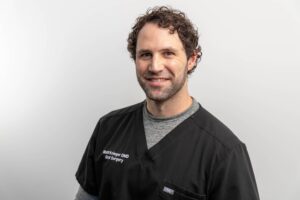
Matthew Krieger DMD
“Failure is simply the opportunity to begin again, this time more intelligently.”
Henry Ford
Q & A with Dr. K
“What type of suture do you use? And do you prefer interrupted or a continuous suture?” |
I use 3.0 chromic gut suture – almost exclusively. Here’s why.
I perform a continuous suture “between implants”. I then tie-off between each implant. I do not run one single continuous suture. Here’s why.
I am also adamant about achieving true primary closure and having the tissue lay as flat and “neat” as possible. I do not “tack tissue closed” as is often a popular technique. While the tissue will heal, I feel that it heals with irregularities that are less than ideal for long term tissue health and hygiene maintenance.