


Confirming osseointegration of full-arch implants is typically done by most providers at the 4 month mark. I also adhere to this standard. There are many different techniques, as well as some fancy instrumentation, that can be used to verify integration. However, in my experience, integration at the 4-month follow up is usually very obvious.
In my practice the initial 4-month evaluation is typically performed by the prosthodontist. They assess the prosthetic, peri-implant health, and implant integration.
If there is any doubt about whether an implant has or has not integrated, I am then asked to assess and evaluate the patient.
When I am asked to assess for confirmation of implant integration and/or possible implant failure, I look for the following:
1. Evaluation of both a panorex and CT image taken that day.
It is often obvious if an implant has failed when viewed on imaging. There will normally be a large area of bone loss and/or radiolucency noted around the implant in question.
However, this is only one step in the process, as there will be times where an implant has failed and looks perfectly normal on imaging.
I must also add that I have evaluated cases where imaging looked suspicious for failure, and yet a clinical exam indicated routine integration of the implant in question.
2. The presence or absence of “Subjective Symptoms”.
The patient should not be having pain, tenderness, or irritation at an implant site at the 4-month mark.
Most of the time, if a patient is having symptoms they will actually be able to tell you if their implant has failed.
Note that the presence of symptoms often indicates failure. However, there are also other reasons implants can be symptomatic aside from failure.
3. The presence or absence of “Clinical Signs” of infection.
The patient should not have evidence of swelling, purulence, erythema and/or tenderness to palpation at this time in the healing process.
4. The presence or absence of “Implant Stability”.
If an implant has not integrated – it will most often present with notable mobility.
This should be very easy to tell. Often all that is needed to confirm mobility is manual digital pressure on the abutment.
A torque test of the implant can also be performed if there is uncertainty. I would agree that the torque test is the gold standard. However, the reason that I do not always perform a torque test, is that it is simply not always necessary.
I perform manual digital pressure on the implant abutment first (pushing with my fingers is just a lot quicker and easier). If there is movement, I know that the implant has failed without the need to perform a torque test.
From a surgeon’s viewpoint… That’s all that is typically ever required. Not too much rocket science here.
The take home message: If an implant hasn’t integrated… it’s usually painful, mobile, and quite obvious.
I am often asked about a percussion test. If for some reason I am uncertain, I will also perform a percussion test on the implant/abutment but this is not something I normally do.
There is nothing wrong with doing this and it can provide valuable information. And, I do use this technique at times.
However, this is just further down the list for me in my assessment. As a result, I find that I am usually certain of either integration or failure before I reach the need to percussion test.
*Also keep in mind that I am typically only asked to assess implants that are in question. The prosthodontist in the practice completes the “routine” implant checks where things such as a percussion test may prove more valuable.
“Nothing is as invisible as the obvious.”
Richard Farson
Q & A with Dr. K
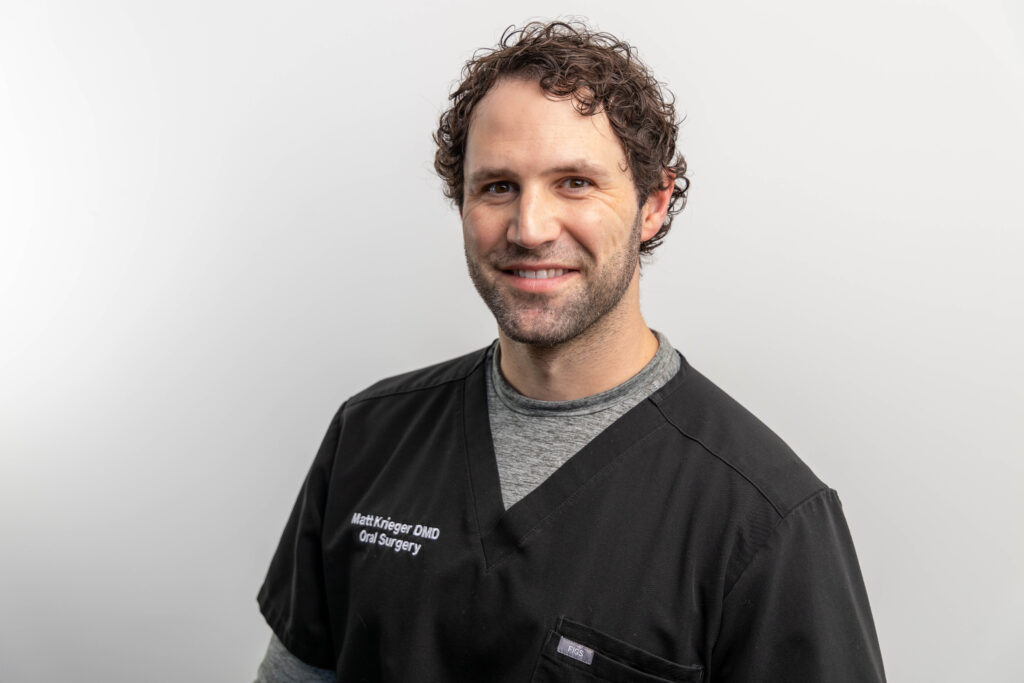
“Why do you wear multiple masks?” |
|
Not a ground breaking clinical question but an astute observation nonetheless. Believe it or not, I actually typically wear 2-3 masks. This has nothing to do with “respiratory safety”. Because of the bone and blood debris created during AOX surgery, I normally wear either protective eyewear glasses or a mask with a face shield component. I have tried just about everything to prevent my glasses and/or face shield from fogging up… The ONLY thing that I have found to work is wearing 2 traditional masks under the glasses and/or faceshield mask, and then placing a piece of tape across the bridge of my nose to secure those two masks and prevent airflow from escaping vertically toward the shield. This has been successful in completely eliminating any fogging of my face shield or glasses. I’ll admit it’s not the most comfortable – but it allows me a clear visual field. If anyone has any better ideas please share! Thank you – |