

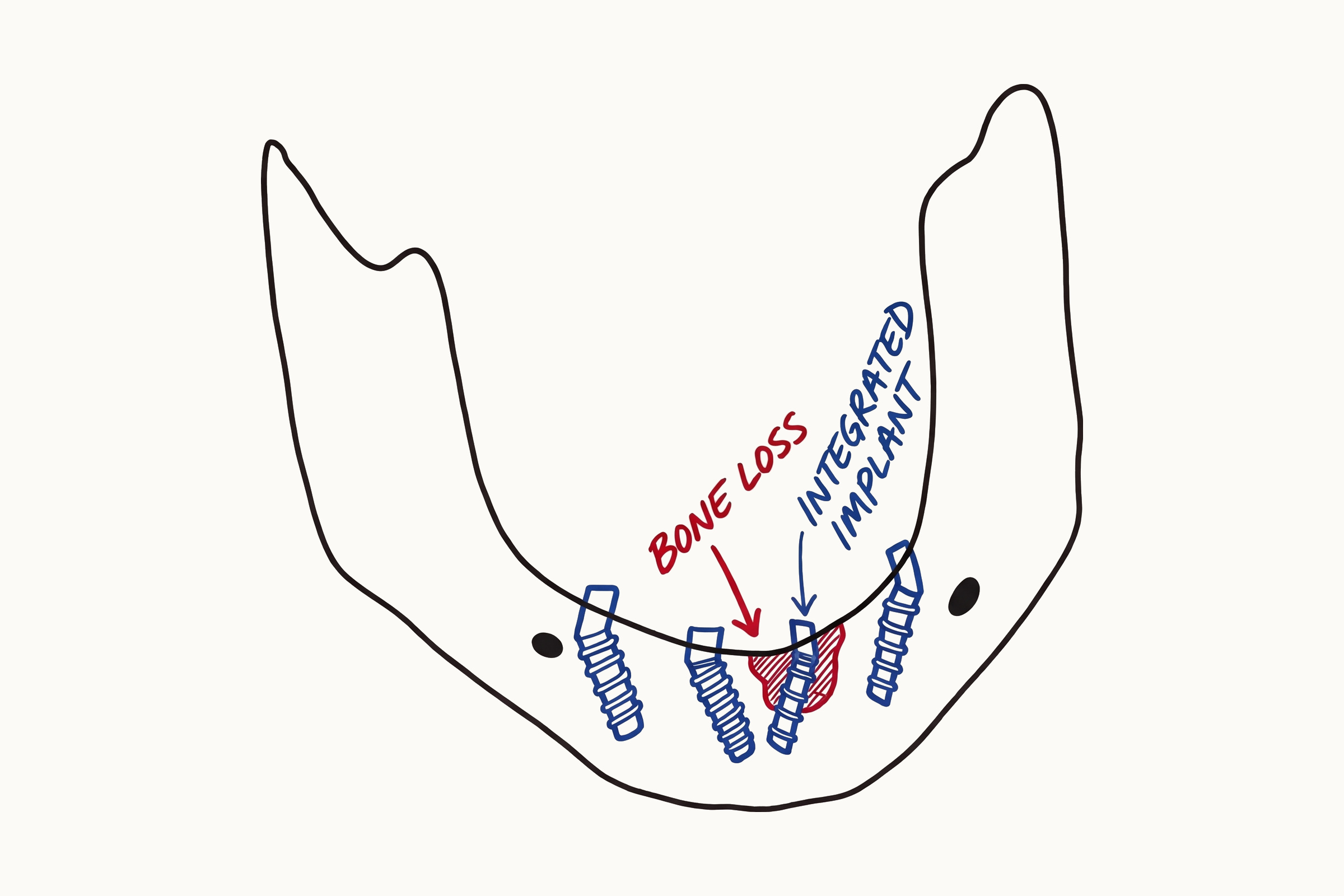
Existing full-arch patients presenting with bone loss at an implant site can be a stressful and sometimes confusing situation to manage. Sometimes the best course of action is removal of the implant. Occasionally, monitoring or increased hygiene recall is the answer. However, there are times when intervening with a graft procedure is indicated. Today’s article will cover when I prefer to graft an integrated AOX implant, as opposed to removal or monitoring.
The decision to graft ultimately hinges on four key pieces of information:
1. Is there an active purulent infection?
I won’t place a graft in an acute, purulent infection. The infection needs to be appropriately managed prior to any graft consideration.
2. Is the type of defect able to be predictably grafted, and what type of graft will that entail?
Does the patient have vertical bone loss, horizontal bone loss, or both? Can we predictably graft the defect? How complex will the graft procedure be to get a result that will actually make a difference?
While grafting is always an option, sometimes the difficulty of performing the graft, the predictability, and the time needed to heal make simply removing the implant and using a new site more appealing for both practitioner and patient.
If the decision to remove the implant with bone loss is made and a new site is selected, the decision to graft the removal site becomes patient-specific.
3. Are there other implant sites that are easily accessible and usable, or is the patient’s prosthetic dependent on this implant site?
As stated above, sometimes grafting can be far more cumbersome than simply selecting a new implant site. However, this depends on whether the patient actually has another implant site available. If they don’t, grafting and saving the implant become more important.
4. Is any intervention needed at all?
I have learned the hard way that “always surgically intervening” on an implant with bone loss is not necessarily the best course of action. It is true that some type of action should always be taken. However, if the patient is asymptomatic, functioning well, and happy, the first step might simply be improved hygiene and shorter hygiene recall. Trying to prevent further bone loss (if it can be effectively accomplished) can often be a better service to the patient than immediately defaulting to additional surgery, which carries its own risks.
If I do make the determination that saving an integrated implant presenting with significant bone loss is the best course of action, there are a few things I do in the setting of full-arch surgery to increase the chances of graft success.
1. Bury the implant
I have found over my career that grafting an integrated implant site and leaving that implant in function with an MUA in place almost always results in less-than-ideal graft healing. I believe this is due to the inherent communication between the oral cavity and the graft/implant/abutment interface. Furthermore, patients needing to perform hygiene (i.e., water-pik use) typically compromise the graft site even if this is delayed for a couple of weeks.
Therefore, when a graft is indicated, I attempt to create a surgical plan that allows the implant to be completely buried with a cover screw. This requires taking the implant out of function and either temporarily loading the patient on the remaining implants or adding a new implant at a site separate from the graft for additional support.
2. Coverage of the graft site with PRF or a resorbable collagen membrane
While I do not always cover the occasional small particulate graft of AOX implants at the time of placement, I always perform coverage with either PRF or a collagen membrane at these larger graft sites that are treating existing implant site bone loss and defects. Primary closure is achieved over the membrane.
3. Re-assess and re-attach the implant to the prosthetic at the 4-month mark
In the vast majority of cases, a 4-month healing period is allowed. Following this time, the graft has healed sufficiently, and the implant is uncovered, an MUA is placed, and the prosthetic is reloaded at this site.

While thankfully this is not a procedure I commonly perform, it will pop up from time to time and become more frequent the longer you practice and follow your surgical patients.
In my experience, the biggest piece of advice I can share is that temporarily burying an existing implant graft site is far more effective than immediately reloading it (in my hands anyway).
While it is my hope that you do not need to perform this procedure frequently, may this help when you need it most.
Sincerely,
Matt