

A failed full-arch implant can have one of three causative factors (or a combination of the three):
- The Patient
- The Surgery
- The Prosthetic
Knowing which of the 3 has led to the failure is key to preventing its recurrence.
For example, if an implant failure is due to poor occlusion and the implant is simply removed and replaced back into the same occlusion, the failure is very likely to occur again. The problem, i.e., occlusion, has not been addressed.
This is a nice example. However, in reality, pinpointing the exact causative factor can be difficult.
So, what do I do if I am unsure what caused an implant failure, or if I have a patient with a recurring failure?
When anatomically possible, I consider the following:
I remove the failed implant and replace a new implant in a similar but slightly different location (meaning close to the failed osteotomy but not in the exact same osteotomy).
Then, I bury this implant.
Next, I place an additional implant distal to the failed site and immediately load this implant, allowing the patient to leave with teeth that day.
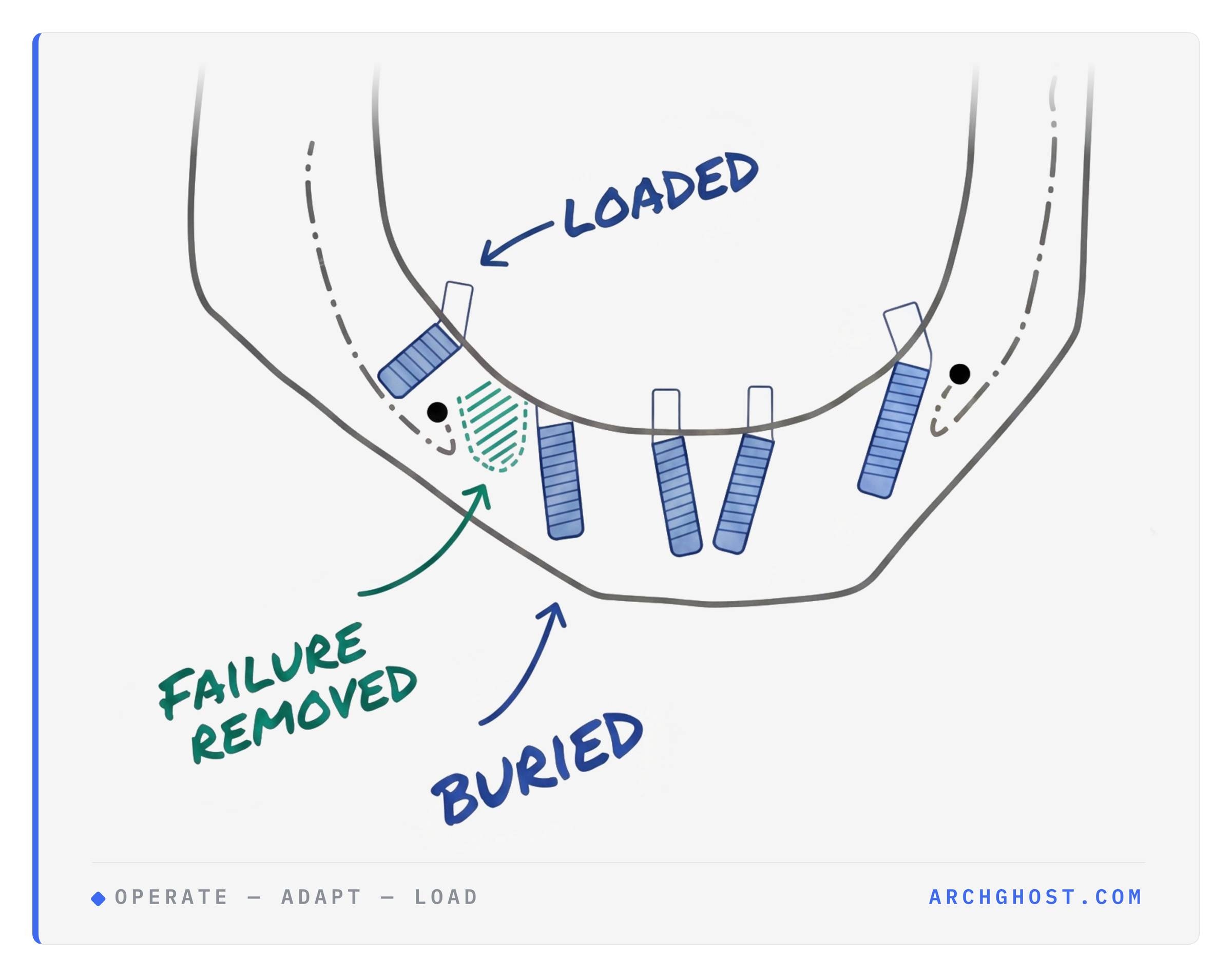
Burying the implant near the failure site allows me two advantages:
- I have a non-loaded implant that can provide a future surgical “out”.
- It provides me diagnostic value. This allows me to isolate “surgical healing” and remove the two factors that I cannot control or account for as the surgeon: Patient Compliance and Prosthetic Forces.
If the buried implant does not heal, we truly have a surgical issue (e.g., poor technique, poor site selection, overheating of bone, etc.) and/or an inability of the patient to mount a proper healing response, which may require medical optimization.
If the implant heals without issue, this suggests the original failure was very likely not a “surgical failure” and was more likely related to either patient compliance or prosthetic management. This is further confirmed if the buried implant heals and the newly added distal immediately loaded implant returns with issues at 4 months. This suggests that an applied force is the problem for the loaded implant.
We must, however, be aware that one aspect of surgical healing is not accounted for when an implant is buried: AP spread. If AP spread is poor, this can create a long cantilever. This may lead to failure of a loaded implant, which, when buried, will heal and give you a false sense of security.
Assuming, however, that AP spread was adequate at the time of the original failure, a buried implant that heals indicates that the original failure was unlikely to be a surgical issue.
As a result of a healed, buried implant, we now know that the likely causative factor for the failure was either the patient and/or the prosthetic.
Given this information, a closer look at patient hygiene and diet compliance is indicated, as well as an evaluation of the prosthetic. Is occlusion balanced? Is the cantilever acceptable, etc.?
Understanding WHY an implant failed is essential to effectively treating the failure and preventing its recurrence. However, determining why can often be difficult.
As surgeons, burying an implant can eliminate factors beyond our control (the patient and the prosthetic) and, to some extent, isolate the potential causative factors for evaluation.
We will all have failures. But those of us who understand WHY we have failures, will have far fewer.
Please note that this is not the protocol I use to treat “every failure”. This is simply a diagnostic tool for patients who present with recurring failures and/or failures that are difficult to understand why they are occurring.
“You only have to change the value of one variable to affect the outcome of the whole equation.”
Susanna Kearsley