

Full-arch surgery very often requires a team approach, combining the expertise of both a surgical and a restorative provider. Optimal surgical and prosthetic outcomes are more likely to occur when both parties are clearly aware of their responsibilities and roles and communicate effectively.
Having focused solely on the surgical aspect of full-arch care for the past 7.5 years, I have exclusively worked within this team approach. If I’m honest, I’ve had the luxury of working in some highly effective teams and the frustration of working in some that are less than ideal.
Following these experiences, I have learned that the best full-arch teams have a clear understanding of the roles and responsibilities below. While there can be an endless number of items necessary to make a case successful, the following list breaks down the two most important responsibilities that ultimately yield the best results when clearly accounted for by each practitioner.
Full-Arch Provider Roles and Responsibilities
Surgeon
The two primary roles of the full-arch surgeon are to provide adequate AP spread and torque. These clinical outcomes are in the direct control of the full-arch surgeon.
1. AP Spread
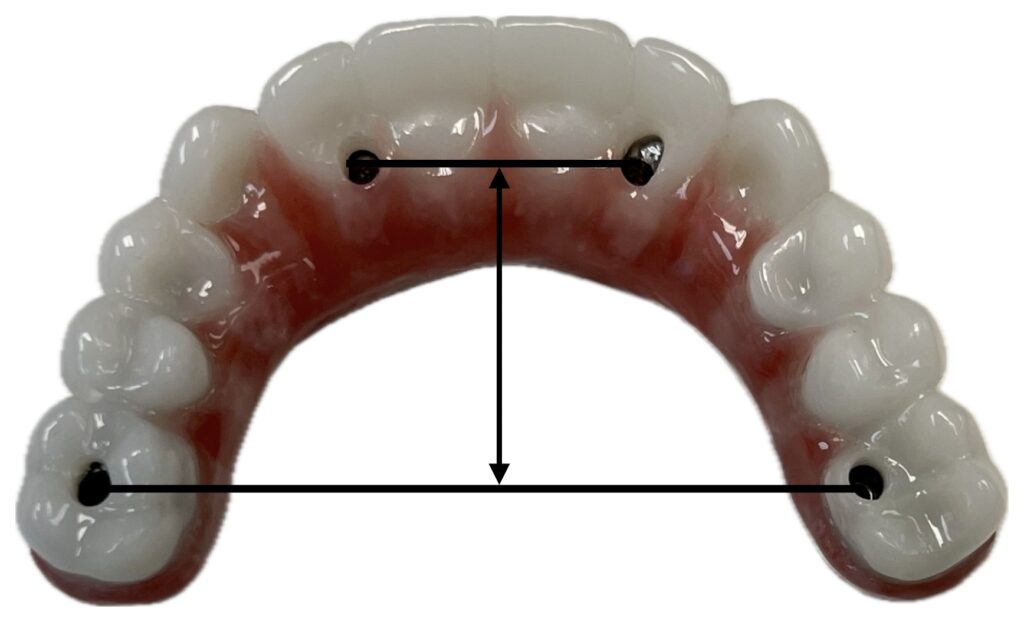
In layman’s terms, AP spread is the distance between your anterior and posterior implants. The greater this distance, in theory, the larger the prosthetic cantilever your implant distribution can support. Ironically, the larger the AP spread you achieve, the less of a prosthetic cantilever that will exist, and at times, no cantilever at all.
There are many articles that reference different proposed tolerated cantilever lengths and cantilever-to-AP spread ratios. My intraoperative clinical goal is to achieve an AP spread that creates a one-tooth-or-less cantilever.
As the surgeon, it is my job to deliver this AP spread clinically.
2. Torque
Achieving optimal torque is the surgeon’s responsibility. While bone density and volume can affect this, it is the job of an experienced surgeon to learn how to circumvent these situations and consistently deliver great torque.
While the accepted loadable composite torque value (CTV) is often quoted as 120 N-cm, my personal clinical goal is a torque of 45 N-cm or higher per implant and a CTV of 180 N-cm or more per immediately loaded case.
As the surgeon, part of my role is to consistently deliver this torque clinically.

When AP spread and/or torque cannot be achieved to the surgeon’s satisfaction, this needs to be communicated to the restorative provider intraoperatively. A discussion is then had as to whether there are any additional surgical options that could improve the case.
If not, a secondary discussion is held to determine what can be done on the prosthetic side to improve the less-than-ideal surgical situation. The communication and timing of this discussion are key.
Restorative
The two primary roles of the restorative provider are occlusion and cantilever length.
These are in the direct control of the restorative provider and have a huge impact on the prosthetic and surgical success of the case.
These responsibilities carry just as much, if not more, importance than the surgery itself.
1. Occlusion
Creating a balanced occlusion (and all the nuances that come with it) is beyond the scope of this article and my area of expertise. However, the need and the importance of doing so are critical and rest with the restorative provider.
No matter how well a surgery is done, if a prosthetic with poor occlusion is loaded, there is a very high likelihood of significant implant failure.
“A well-done surgery will always struggle to overcome a poorly done prosthetic.”
Balanced occlusion is the direct responsibility of the restorative provider.
2. Cantilever Length
Managing cantilever length and ensuring it does not exceed the pre-set parameters of the surgeon/restorative practitioners’ guidelines is the role and responsibility of the restorative provider.
Now I know what you might be thinking:
“Hey, you said AP spread was the surgeon’s responsibility? And therefore, as the restorative doctor, I cannot control the cantilever??”
The statement above is both true and false.
True: AP Spread is the responsibility of the surgeon.
False: The restorative provider cannot control the cantilever.
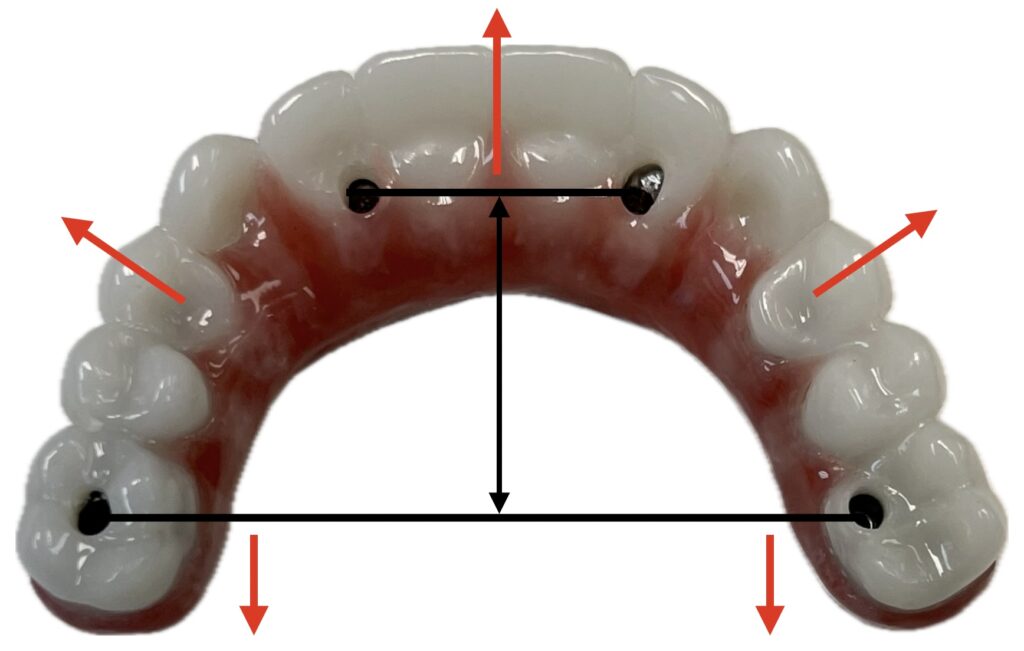
AP spread and cantilever are intimately related but are not the same thing.
AP spread is a measurement that is related to a clinical outcome. Cantilever is a “choice” after the fact.
The restorative provider is in complete control of the cantilever. As the restorative practitioner, you have the blessing and curse of completing the prosthetic portion after the surgery is done.
This means that a critical part of your job is adapting to the surgery and optimizing the surgery as much as possible.
While the AP spread provided to you by your surgeon might be either phenomenal or incredibly poor… You decide what you are going to do with it after the fact.
You have the choice, knowledge, and skill to either ignore an issue at hand and “just place the teeth on as originally planned” or to adapt and “alter the prosthetic” in some way (ie smaller arch, dropping a tooth, arch rotation, A/P movement, tooth inclination, etc. ) in an effort to offset a less than ideal cantilever and improve the case biomechanically.
I understand this is not ideal, but it is a necessary skill and course of action to have consistent full-arch success.
Now, if your surgeon is consistently providing you poor AP spread there’s another issue at hand.
However, once in a while, when the surgeon has not done their job well (which happens from time to time) and delivers a less-than-ideal AP spread, the restorative practitioner now has to step-up and assume responsibility for both occlusion and cantilever length.
This is a huge responsibility and one that requires great skill and attention to detail. Occlusion and cantilever length are so powerful and impactful on full-arch outcomes that a skilled restorative provider can turn even a mediocre or poorly performed surgery into a successful case by controlling and optimizing these factors. On the other hand, a skilled surgeon has far less success trying to “overcome” a poorly done occlusion or a less-than-ideal cantilever length.
Mindset Shift
Mutually understanding the surgeon and restorative provider roles will be a game changer for your practice or referral relationship. When these are not understood (and I’ve been there), it creates a tense relationship without trust that does not deliver optimal results. Each provider feels the other is not doing their job.
When each provider understands these responsibilities, it creates an environment of trust and a strong desire to improve surgical and prosthetic outcomes through collaboration.
For example, a less experienced surgeon may say, “Hey, this is the only torque and AP spread I could get because the bone was soft and the sinuses were pneumatized.”
An experienced surgeon is going to say,
“Hey, this is a tough case due to both low-density bone and bone availability. I want to show you my AP spread and discuss additional options we have to improve our position in the arch and overall CTV. If I can’t achieve that, what can you do on the prosthetic end to help?”
The same happens on the restorative side.
When working with less experienced restorative practitioners, I’m often met with resistance in a difficult case: “Well, I can’t do much. This is a surgical issue. I need to place the teeth regardless as planned”.
Experienced and skilled restorative providers have a different response,
“I see this is a tough case and you’ve done and tried everything in your toolbox. I know the cantilever with our original plan won’t work. Let me see what I can do. I’m going to make some adjustments on the prosthetic end to make this more favorable biomechanically.”
The difference in understanding each provider’s role and the teamwork behind this mindset shift will significantly improve surgical outcomes and full-arch success. For those of you in a “team setting” or “referral setting”, I challenge you to have this discussion with your referring provider (either the surgeon or the restorative provider) and to clearly outline “who does what” and what communication regarding those responsibilities looks like.
P.S.
This article is in no way meant to “point blame” upon either the surgeon or the restorative doctor. It is, in fact, the opposite. It is to unite both providers under the shared responsibility of the mutual arch and to showcase how interconnected their roles are to the success of the procedure.