
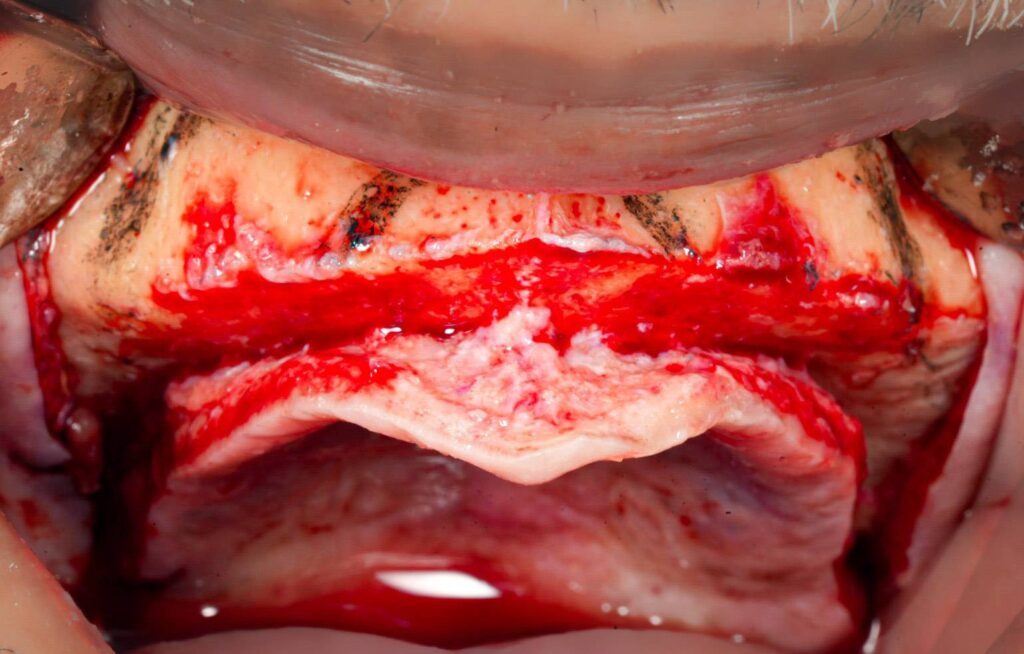
Retracting the palatal tissue via “stay sutures” is a popular technique for providing improved visual access to the maxillary arch during AOX surgery.
While this is a completely valid and arguably beneficial technique, I deliberately choose not to perform palatal stay sutures during full arch surgery.
Listed below are the 5 primary reasons I do not employ this technique.
5 Reasons I Do Not Use Palatal Stay Sutures
1. In my hands this is an expensive habit.
I normally use 2 sutures per jaw for closure. Therefore, 4 packets of 3.0 chromic gut suture are utilized (nearly entirely) to close a double arch case.
Now, I will admit that I use more suture than most. This is the result of an attempt to have a water-tight closure with well approximated, flat tissue margins.
Because the volume of my suture use is very consistent, utilizing that extra suture to secure the palatal tissue would often “tip me over” into needing 5 suture packets instead of 4.
I do not feel that using an extra suture for every patient, just to retract the palatal tissue, is the best use of my practice overhead.
Now, this may very well not be the case for you – as your suture use may be different than mine. Nonetheless, some food for thought.
2. With optimal utilization of my surgical team, palatal stay sutures are unnecessary and an inefficient use of time.
While there is absolutely nothing wrong with palatal stay sutures, I simply do not find them necessary. They aren’t providing me anymore benefit (and in fact less) than a simple malleable retractor managed by my assistant.
I always try to have a reason for everything that I do in surgery. In my hands, stay sutures are simply an additional step that provides little to no benefit, and yet actually requires both extra time and suture.
The only instance in which I would argue that this may be worth the extra time and suture, is to help with capturing intra-oral photography images (*which I have done in some of my photos).
3. The palatal stay suture technique does not actually protect the tissue.
Yes, this technique does help move the tissue “mostly” out of the way. However, the tissue is not actually protected.
You can still catch the tissue with a rongeur, barrel bur, or saw and rip or cut the tissue. This is less than ideal and can create poor tissue management for closure or annoying intra-op bleeds to manage.
4. Stay sutures do not allow for placement of the maxillary troughed guide.
During reduction, the guide (in addition to extracted teeth) can be used to check for adequate reduction.
Furthermore, the upper and lower guides are placed simultaneously to ensure that the post-op VDO has been obtained – another indicator of adequate reduction.
The maxillary troughed guide cannot be positioned with stay sutures in place. If they are cut out to position the guide, and additional reduction is indicated, the sutures have to be placed a second time. Again, an inefficient use of time and suture.
5. The malleable retractor is safer, more cost-effective, and more efficient.
The last reason I do not use the palatal stay suture technique is that the alternative, in my hands, is simply better.
I have my chairside assistant follow me during maxillary reduction with the malleable retractor. The malleable retracts the palatal tissue for improved access, while also providing a safe barrier between the cutting instrument and the soft tissue.
This improved safety protects not only the maxillary soft tissue, but also adds an additional level of safety for protecting the tongue (a tongue rake is also used) should the barrel bur slip at all in the posterior maxilla.
This retractor also comes at no added expense or overhead – other than the initial investment.
While I do not feel this to be ground breaking information, this is a glimpse into my mental thought process of AOX theory and an attempt to optimize each and every aspect of this surgery.
Having a reason for everything you do in AOX surgery is important when taking your surgery to the next level. Your surgery, and your technique may look different than mine. That’s fine. But I challenge you to always know “why” you do what you do.
Matthew Krieger DMD
“The noblest pleasure is the joy of understanding.”
Leonardo da Vinci
Q & A with Dr. K
“What do you think is the most often overlooked aspect of AOX surgery?” |
Hands down – “Closure”.
In my opinion, not enough attention is paid to closure. I think closure is crucial for long term implant and prosthetic health.
While it is true that the soft tissue will heal if we simply “tack” the tissue closed with one suture between implants – it will very likely not heal optimally.
Both time and attention should be paid to a meticulous closure to allow for optimal soft tissue healing that will lay flat and smooth around implants as well as underneath the prosthetic. This provides improved healing, less food impaction, and enhanced long term implant and prosthetic benefits.