
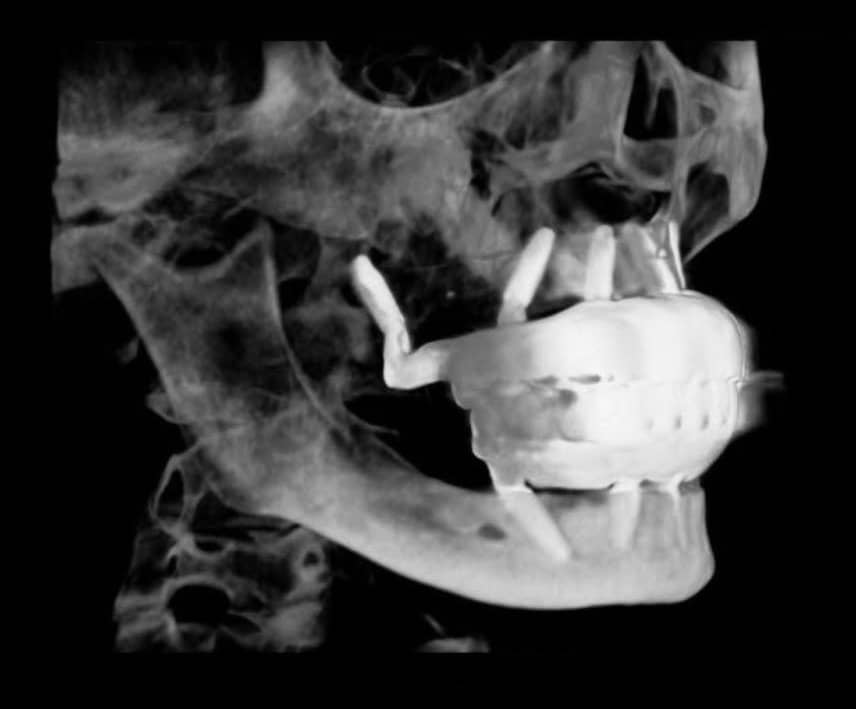
I have yet to bury a pterygoid implant at the time of surgical placement. I want to admit that in writing this, I will probably have to bury a pterygoid implant within the next week. That’s just how life works.
However, burying a pterygoid implant is a practice that I attempt to avoid and I want to review why this is the case.
4 Reasons Why I Attempt to Avoid Burying a Pterygoid Implant at the Time of Placement
1. I place a pterygoid implant in order to help eliminate an excessive cantilever.
The most critical time for the pterygoid implant to provide help with elimination of the cantilever is during the 4 month integration period. If the implant is buried during this time, it is providing no benefit.
If I cannot successfully place a pterygoid implant for a case in need of cantilever elimination, I look at other options. The goal being to provide immediate cantilever relief during the 4 month osseointegration period.
2. If implant torque is too low to load, I worry that I am in the wrong place.
The pterygomaxillary pillar is a very dense island of cortical bone (the vast majority of the time). As such, implant torques in this region should be relatively high if properly engaged.
Therefore, if I place a pterygoid implant and I am only achieving 20 N-cm of torque – I am actually concerned that I have not properly engaged the pterygomaxillary pillar and that I am in the wrong place.
For this reason, I do not bury the implant (or load it), but remove it instead.
3. I only place pterygoid implants when “I need them”.
I do not place pterygoid implants on every patient. I only place them if I actually need them. And if I place them, I want to use them.
Placement is typically due to one of two reasons:
Elimination of a cantilever.
Improved composite torque for immediate loading.
If I bury the implant – neither of these areas of concern are addressed during the integration period. As a result, if I feel the pteryoid implant is not loadable, I will remove it and look for other solutions.
4. I attempt to achieve symmetry (as much as possible).
I know, I know – this is not always possible.
There are cases where I am planning bilateral pterygoid implants, and I am unable to place the initial pterygoid. In this scenario, I will reassess if there is another non-pterygoid option, such as palatal root implants, that could be placed bilaterally to maintain a symmetric prosthetic.
Sometimes the answer is no. Sometimes the answer is yes.
But nonetheless, I am removing the pterygoid that I was not happy with and am looking for other options – with an emphasis on symmetry as much as feasibly possible.
The above practice is simply personal preference and is not a hard and fast rule. However, as always, my goal is to share a small glimpse into my AOX thought process and surgical theory.
Matthew Krieger DMD
P.S.
There have been a handful of cases (while not common) in which patients have not liked the feeling of the pterygoid implant extension. In these cases I will maintain the pterygoid implant throughout the integration process to provide the important benefit for which it was placed (cantilever elimination/improved CTV). After integration, if it is feasible based on A-P spread, I will de-load and bury the pterygoid implants. Note that while this is an option for some patients, this is case dependent and is not an option for all patients.
“Challenges are what make life interesting and overcoming them is what makes life meaningful.”
Jocko Willink
Q & A with Dr. K
“How do you handle patients who are smokers?” |
The short answer is: Just like every other patient.
This is always a topic of controversy and debate in implant surgery – and even more so in full-arch surgery.
Yes – I educate all of my AOX patients on the importance of smoking cessation.
Yes – I would prefer that all of my AOX patients quit smoking and never go back.
Yes – All of my AOX patients agree prior to surgery to quit smoking for the health of their prosthetic.
How many do I think actually quit? Likely less than 1%. Smoking is incredibly difficult to quit and thinking that all of our patients are going to quit is unrealistic.
A significant number of full-arch patients smoke. So, the reality is, unless you are going to do a greatly reduced volume of patients in your practice – treating smokers is just part of the deal.
Beyond educating patients about smoking in the pre-op stage… I really don’t worry much about it and don’t necessarily do anything differently. I feel that this aspect of surgery is, for the most part, out of my control.
While I have likely had some failures due to smoking, I have had countless successful integrations in smokers as well.
I want to be clear that I am not advocating to not pay attention to smoking at all. I simply find it difficult and unrealistic to “not treat smokers” and/or “to think that all of them will quit” for surgery.
I would like to add that there are nicotine tests that can be administered. I think this testing does have its place but that it can also be awkward to enforce with patients.
I admit that I do not have all the answers when it comes to smoking – and there may very well be better protocols out there. This is simply how I handle this controversial topic.
P.S. Heavy, heavy smoking does play a role in treatment decisions, especially extensive hard/soft tissue grafting.
I will also add that I still think critically on each and every patient – while I do not “not treat” smokers – there are always extremes. Someone who smokes 2 packs/day may not be the best AOX candidate.