
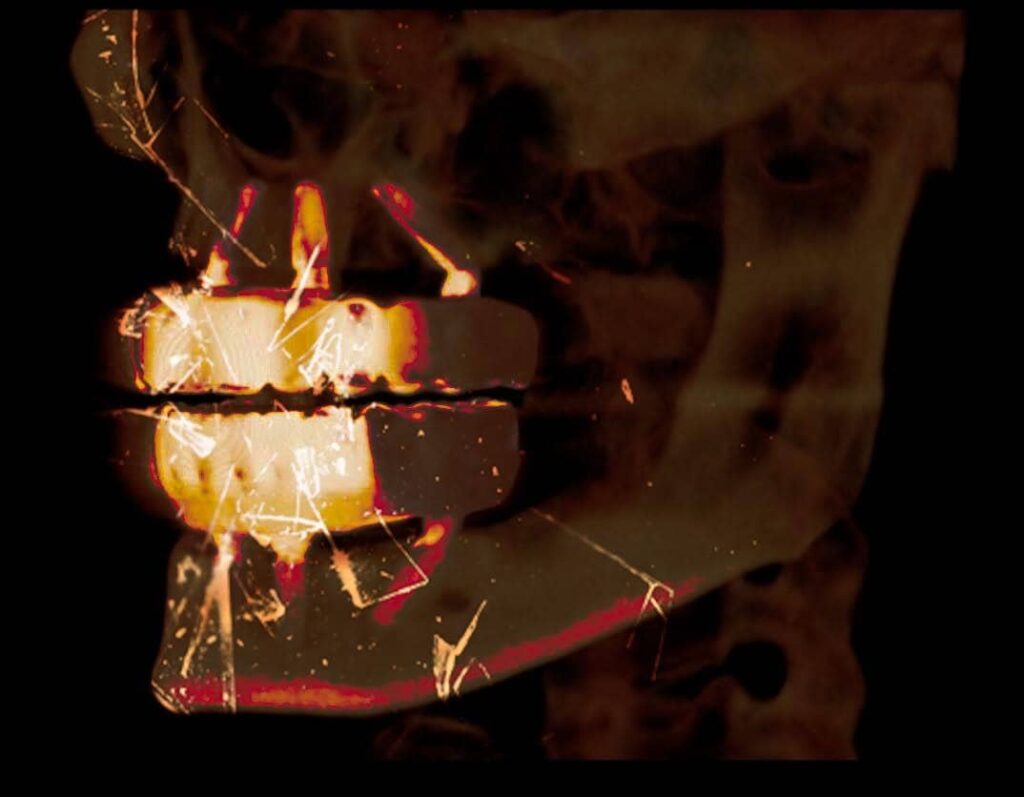
The dreaded total arch failure.
An uncommon occurrence, but a devastating one nonetheless for both patient and practitioner.
In my clinical experience, there are 3 key suspects in a total arch failure.
Assessing and accounting for these during the treatment process can save us a lot of headache.
I want to ensure that we all understand there are many, many reasons why full-arch implants can and do fail. However, I have noted these 3 causes to be the most common in the setting of a total arch failure.
The 3 Most Common Causes of a Total Arch Failure
1. A Poorly Made Prosthetic
I know that the surgeon is the easiest target to point at when there is an implant failure.
However, the prosthetic portion of AOX surgery is just as important to implant integration, if not more important than the actual implant surgery itself.
If a prosthetic is poorly made, or occlusion is off, the possibility of multi or total implant failure goes up drastically. Implants that are attempting to integrate simply cannot handle maldistributed forces and poor occlusion.
Ensuring that the prosthetic fabrication is on point and/or that there is a skilled restorative referral, is critical to consistent AOX success.
2. Severe Immunosuppression and/or Medication Related Suppression of Implant Integration
For obvious reasons, there is a higher incidence of implant related failure in patients who are immunosuppressed. There are also a number of medications known as “implant killers” that can and do affect implant integration.
While a discussion of these comorbidities and medications can span “multiple lectures”, it is safe to say that total full-arch failures are more likely in this patient population. I have seen this scenario firsthand in my own practice.
In order to successfully manage these patients it is imperative to understand when to move forward, how to optimize them medically for surgery, or when to simply say no.
3. Severe Bruxism
As discussed in a recent blog post, I do feel it is possible to successfully treat bruxism patients with full-arch surgery. That being said, this group does have the potential to create problems with implant integration. And, when a total arch failure does occur, this parafunctional habit often plays a key role.
In order to limit this unwanted possibility, it is necessary to have a well designed surgical and prosthetic plan tailored to limit bruxism related risks – BEFORE surgery is ever carried out. This plan must include both surgical and prosthetic adjustments in order to improve the likelihood of successful implant integration, as well as the long-term life of the prosthetic.
While the surgeon is always responsible for their case – in my experience a total arch failure should often (but not always) prompt an evaluation “outside of surgical technique”.
The majority of the time, a total failure is related to a mechanical disturbance (poorly fitting prosthetic and/or bruxism) or a true inability of the patient to heal (severely immunocompromised state or presence of integration inhibitory medications).
If you ever find yourself in this situation, keep this in mind and think “outside the surgical box”.
Matthew Krieger DMD
“Nothing is as invisible as the obvious.”
Richard Farson
Q & A with Dr. K
“What’s your advice for a chief resident wanting to go into full-arch surgery upon graduation?” |
Simple.
1. Focus on learning what your residency has to offer (whether trauma, orthognathic, cosmetic etc). Your diverse surgical skill-set will serve you well in full-arch surgery.
2. Read this newsletter and the AOX blog each week for the remainder of your chief year. While I am biased… I truly believe that if you do this – this will put you ahead of 95% of graduates in terms of the breadth and depth of your full-arch knowledge. Even if you’ve never cut an arch.
3. Take a full or part-time job at an AOX focused practice with a goal to cut 250 arches or more your first year out of residency.
This will put you well ahead of the curve and on the path to full-arch success.