
The anterior mandible is an anatomic region well known for its dense bone and predictable implant torque.
But… The lower anterior jaw has its own unique challenges and is great at camouflaging them in a false sense of surgical confidence.
When assessing the anterior mandible, we can easily be deceived by how much bone availability we actually have. When measuring from our reduction point on the panorex, at first glance we may feel that we have 20 or even 25 mm of bone stock!
When assessing our CT image in the sagittal plane, we get a more accurate picture, but may still feel we have 20 mm of bone stock or more when measuring from the inferior border to the level of our anticipated reduction.
So why can this be deceptive?
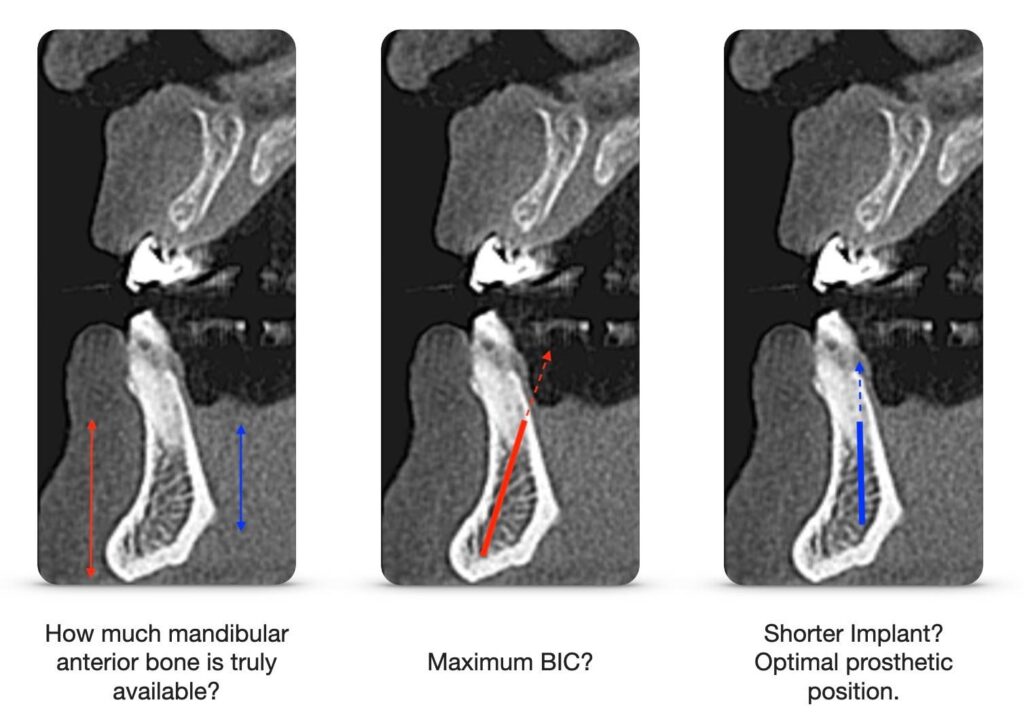
Many, but not all mandibles, present with a “J” or “L” shape (depending upon which direction you are looking from). This is a result of increased bone deposition at the site of the mental protuberance. Reference the photo above for a visual of this shape.
In a non full-arch implant scenario – without bone reduction – this is almost completely irrelevant. This is because our implant placement is well above the point of the mandible where this “J or L” transition takes place.
However, as a result of the bone reduction requirements in full-arch surgery, we are now closer to this anatomical “directional change” and need to account for it in our implant planning.
We have two choices in the setting of AOX surgery:
1. Place a longer implant to maximize bone-to-implant contact and follow the anatomical shape of the mandible (see photo above).
In this scenario we will need to correct the angulation with an angulated abutment or the access hole will be notably lingual and create a significant lingual prosthetic shelf – loathed by all patients…
2. Place a shorter implant in a more vertical (or even slightly anteriorly angled position) and avoid the “J/L” shaped anatomical region altogether (see photo above).
This implant will normally provide an optimal prosthetic position via a straight abutment.
In my opinion, neither of these options is right or wrong.
The key is to account for the difference in bone height due to the anatomical angulation of the anterior mandible and strategically select the approach you prefer – and then execute it properly.
If this anatomic variation is not taken into account, and implant angulation adjusted accordingly, there will very likely be a time where we think we have a greater amount of available bone height than we actually do.
In this scenario, the anterior mandibular implants will either perforate out the lingual cortex (I’ve done this) and/or engage the inferior border unintentionally (which can also lead to unwanted complications).
The obvious next question is, “Which option do I prefer?”
I prefer approach #2.
I normally place a shorter implant (4×11.5mm) and place the implant in a more vertical and/or at an every so slight “anterior lean” in order to attempt to achieve an optimal access hole position.
Given the density of the anterior mandible, I consistently achieve torques in the 60-80 N-cm range and therefore do not feel it is necessary to have a longer implant in this region for improved stability.
While I angle every other implant in the jaw, I feel most comfortable achieving optimal positioning with vertical implants (most of the time) in this region. This is strictly personal preference and primarily based on the way I stand and hold the handpiece.
And finally, having seen firsthand and been referred some significant complications over the years from implants that have engaged the inferior border, I tend to avoid encroaching upon this anatomical region.
Here’s to hoping that deceptive mandible won’t get the best of you,
And that proper treatment planning will have you prepared too.
The real question is,
Should that implant be angled or straight?
And now that you know your anatomy,
You shall control your own surgical fate.
Matthew Krieger DMD
“When you know your WHY, you’ll know your WAY.”
Michael Hyatt
Q & A with Dr. K
“Do you think it’s best to sit or stand when performing full-arch surgery? “ |
Sitting or standing (in my opinion) is simply surgeon preference – nothing more or less.
Do whatever feels best to you.
I know great surgeons who sit and great surgeons who stand.
I prefer to stand and feel that this provides me some advantages with the way that I operate.
However, I have also sat at times to help work on posture and give the repetitive nature of what I do a “change” from a musculoskeletal standpoint.
Let your focus be on achieving optimal surgical outcomes and high caliber surgical quality.
However, you can best achieve this – sitting or standing – is the way that you should operate.