
Those of you who have read my articles for some time, know that I am a huge fan of palatal root implants in full-arch surgery.
When a palatal root implant is indicated, I normally utilize the first molar site.
This is because the first molar site more often presents with a true palatal root socket, while the second and third molars have a higher incidence of fused roots and therefore no isolated palatal root socket.
I also prefer the first molar site due to the fact that our practice normally fabricates a “first molar to first molar” ti-bar prosthetic. So any implant site beyond this anatomic location will require a titanium bar extension. Not a big deal, other than the fact that some patients don’t love the feeling of the ti-bar extension.
Despite my frequent use of the first molar site, there are times when I will look beyond this anatomic location and strategically select the second molar for implant placement.
Today, I am going to review the four surgical scenarios in which I prefer to utilize the second molar palatal root site instead of the first.
When I Prefer a Second Molar Palatal Root Implant
1. Low torque at the first molar palatal root site.
While this is not common, it does occur. If the first molar palatal root site does not torque well, and the patient has a second molar palatal root site available, the obvious choice is to attempt to utilize the second molar site and achieve improved torque.
The density will likely be similar. So it is wise to use what we learned from the first palatal root socket to help us adapt our osteotomy technique in order to maximize torque in the second molar site.
Furthermore, sometimes socket depth will vary between molars. We might have only been able to place a 5x8mm implant in the first molar palatal root, and yet may be able to consider a 5x10mm in the second molar socket – therefore improving the likelihood of generating higher torque.
2. Planned second molar dentition.
If I am planning to provide a patient a “second molar to second molar prosthetic”, and the patient has both a first and second molar palatal root site available, I will opt for the second molar site. This is simply to ensure that the cantilever is eliminated entirely.
3. The second molar socket is larger and or has a thicker palatal wall.
As mentioned above, the socket sizes are not always the same. If the second molar site has a notably larger (deeper) socket, then my preference would be to utilize that site.
This is not only to allow for the potential for a larger implant, but also to help limit the chance of entrance into the sinus.
I will also assess the palatal wall. This is where our torque is generated. If the first molar site has a thin palatal wall likely to outfracture, and the second molar site has a thick, strong palatal wall likely to generate high torque… You guessed it – I’ll go with the second molar site.
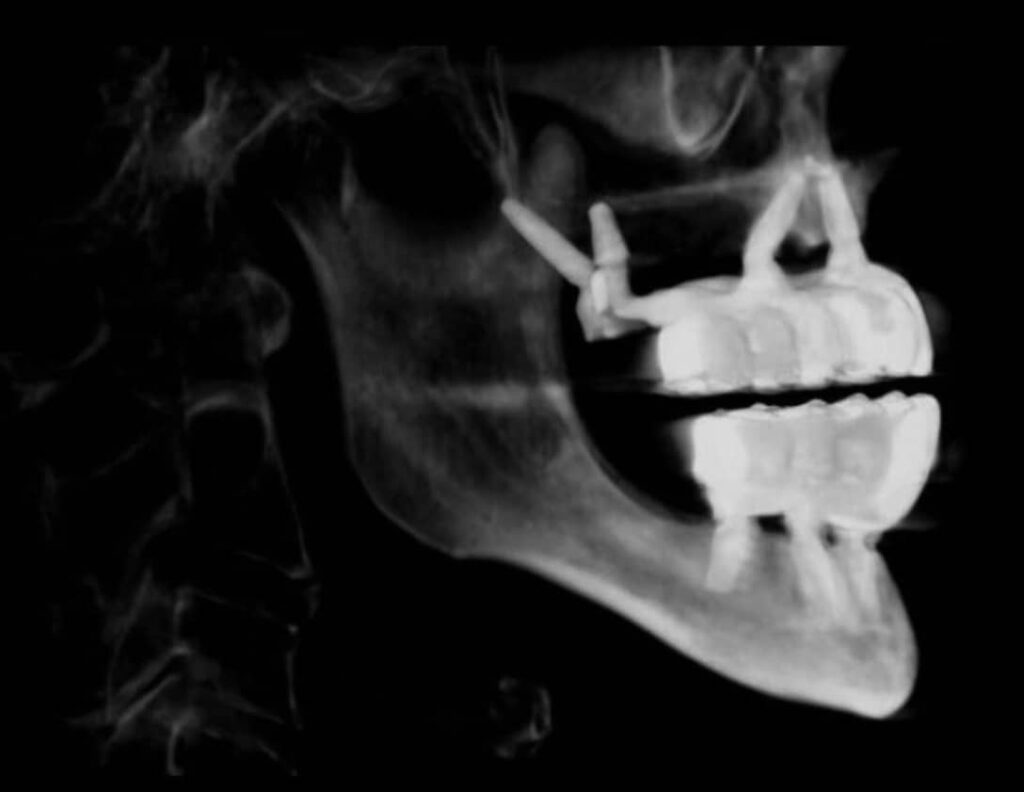
4. Placement of a pterygoid implant was carried out on the contralateral side.
If the opposite side of the arch has a pterygoid implant (as shown in the photo above), but I am unable to achieve placement of a pterygoid implant on the current working side – I will opt for a second molar (or even third molar) palatal root in order to maintain symmetry.
I find that patients are aware of the presence or absence of symmetry and for this reason, as much as possible, I attempt to have symmetrical implant locations.
A second molar palatal root implant will more closely mimic the abutment location of the pterygoid implant and the positional difference will be less discernible to the patient.
For the most part – a palatal root is a palatal root.
Therefore, we can all learn to use this to our advantage and be strategic in site selection in order to optimize the prosthetic outcome and ultimately, our patients’ full-arch satisfaction.
Matthew Krieger DMD
“You cannot make progress without making decisions.”
Jim Rohn
Q & A with Dr. K
“Do you use Densah Burs? And if so, when?” |
I have heard that a lot of practitioners love Densah burs.
Embarrassingly enough…
I have never actually used them.
I have never been part of a practice that has had them and I quite honestly haven’t found a significant need in my day to day surgery where I feel that I would consistently benefit from them.
In my hands, I focus on my control of how the osteotomy is prepped and/or under-prepped, implant selection, angulation, and anatomical bone engagement to try to improve torque.
This technique and strategy is effective for me because I’ve practiced it over and over again – since I’ve never actually had the Densah burs.
Maybe I’m missing out??